



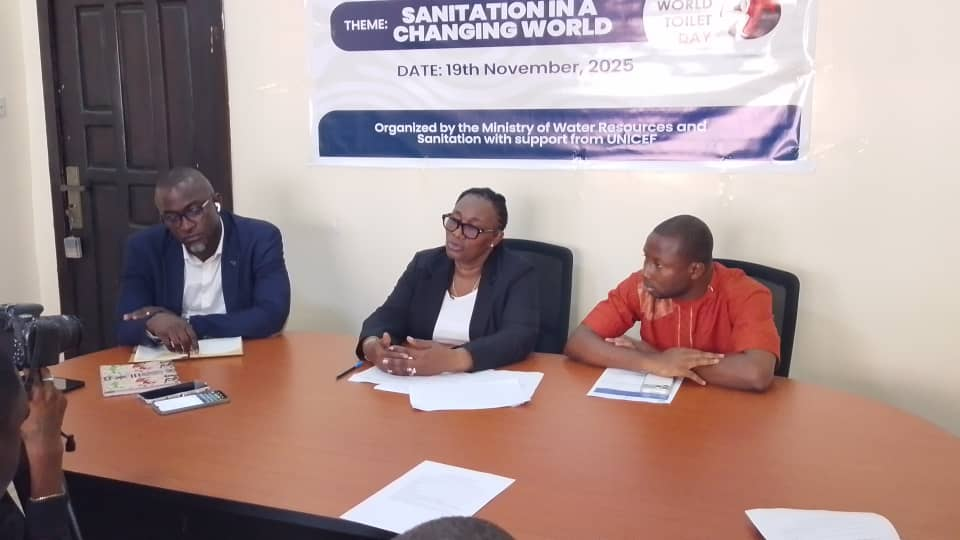
The Ministry of Water Resources and Sanitation and other development partners on 19 November 2025 commemorated World Toilet Day.
Dr. Sao-Kpato Hannah Isata Max-Kyne, the Minister of Water Resources and Sanitation, said they joined the global community to commemorate World Toilet Day 2025 under the theme “Sanitation in a Changing World.”
“This important day reminds us that access to safe sanitation is not merely a matter of convenience; it is a fundamental human right, essential for protecting public health, preserving dignity, and safeguarding our environment,” she explained.
She noted that with this year’s theme, they acknowledge that the world and indeed the cities are changing rapidly. Urban growth, climate variability, and increasing pressure on our environment demand that we rethink how sanitation systems are planned, managed, and sustained to ensure that everyone, everywhere, has access to safe and affordable sanitation services.
According to her, in Sierra Leone, the Ministry of Water Resources and Sanitation, in collaboration with partners and local councils, continues to prioritize safe sanitation for all. Through ongoing Community-Led Total Sanitation (CLTS) initiatives, using the Chiefdom-Wide Approach and the Citywide Inclusive Sanitation (CWIS) strategies, they are striving to ensure that every household, school, health facility, and marketplace has access to safe, affordable, and climate-resilient sanitation facilities.
The Minister said: “As a government, and through the collective efforts of all stakeholders, we have successfully declared and certified 21 chiefdoms as Open Defecation Free (ODF). Just last week, five additional chiefdoms were prepared for declaration, bringing the total to 26 ODF-declared chiefdoms nationwide. In the coming year, more chiefdoms are scheduled for verification and certification, bringing us even closer to achieving our goal of a nation free from open defecation.”
She emphasized that while their progress is commendable, they recognize that challenges remain particularly in urban and peri-urban communities, where issues such as fecal sludge management, inadequate drainage, and environmental pollution persist. To address these challenges, the Ministry is implementing concrete actions:
Implementing the Community-Led Total Sanitation using the Chiefdom-Wide Approach; Supporting the development of City-Wide Inclusive Sanitation plans for the Freetown City Council and Western Area Rural District Council; Expanding behaviour change campaigns under the Clean and Green Salone Initiative to promote hygiene and end open defecation;Enhancing investments in fecal sludge treatment plants, safe disposal, and reuse systems; and
Promoting climate-resilient sanitation infrastructure capable of withstanding floods and environmental shocks. Madam Sao called on all citizens, development partners, civil society organizations, the private sector, and local authorities to join hands in making sanitation everyone’s business. Each household, community, and institution has an important role to play in keeping the country clean, healthy, and green.She added that the occasion should be used to renew collective commitment to ending open defecation, promoting safe sanitation practices, and achieving Sustainable Development Goals by ensuring access to water and sanitation for all.
In responding to the press, Engineer Francis Kallon, the Deputy Minister, said that out of the 21 chiefdoms selected as Open Defecation Free (ODF), they are still pushing for the additional five, which will sum up to 26.He said that for the World Bank project, they have been engaging in the construction of 100 toilets with the Freetown City Council.The Minister said the project, which is more than $180 million, is a ten-year project awarded to them by the World Bank.


