



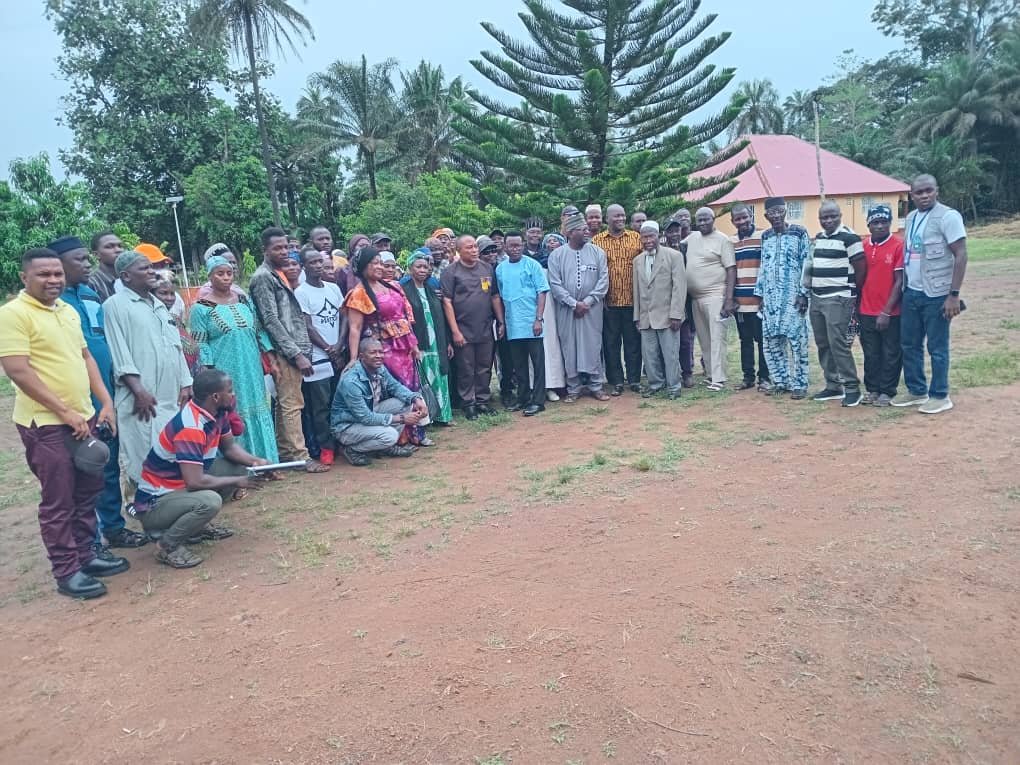
The Ministry of Planning and Economic Development (MoPED), in collaboration with the Ministry of Local Government and Community Affairs (MLGCA), has continued stakeholder consultations on the development of a Chiefdom Development Plan in Gbinle Tawuya Town, Kambia District, engaging traditional authorities, local government representatives and community stakeholders to identify priority development needs and shape a plan that reflects local realities.
The consultation marks the second phase of the engagement, following an initial pre-engagement exercise conducted in the chiefdom eight weeks earlier. It provided an opportunity for community members to review key development challenges, share their perspectives and propose practical interventions to improve living conditions across the chiefdom.
The meeting was chaired by Senior District Officer, Mr Charles Lamin, who underscored the importance of collective participation, collaboration and community ownership in developing a plan that responds to the needs and aspirations of local people.
Addressing participants, the Deputy Development Secretary encouraged stakeholders to take the consultation seriously and provide honest and relevant information about the challenges facing their communities. He emphasised that effective development planning requires active participation and ownership by the people it is intended to serve, reaffirming MoPED’s commitment to engaging communities throughout the planning process.
In his welcome address, Paramount Chief Alhaji Alimamy Serie Sankoh-Yillah II welcomed the MoPED and MLGCA delegation and encouraged stakeholders to participate actively in the discussions to ensure that the priorities identified genuinely reflect the development aspirations of the community.
Representing the technical team, Sylvester Macavoray, Senior Programme Officer in MoPED’s Rural Development Directorate (RDD), outlined the key thematic areas guiding the consultation. These included healthcare access, education and social infrastructure, youth and women’s empowerment, environmental sustainability, food security, infrastructure and community services, governance, peace and social cohesion.
Stakeholders were subsequently organised into five working groups to examine the development challenges within their communities, identify pressing needs and recommend practical solutions.
The group discussions highlighted a range of priorities across the chiefdom. Recommendations included the construction and rehabilitation of schools, improved school furniture and sanitation facilities, solar electricity, teacher accommodation, and the recruitment and training of more qualified teachers.
On agriculture and food security, participants called for improved access to seeds, fertilisers, warehouses and storage facilities, as well as tractors and other farming equipment to strengthen agricultural production. Other priorities raised included livestock support, better rural roads, access to safe drinking water, electricity and improved mobile network coverage.
Discussions on youth, women and environmental sustainability also highlighted the need for employment opportunities, greater support for women, youth empowerment and stronger environmental protection measures.
Following the group discussions, representatives presented their findings during a plenary session, allowing stakeholders to examine shared challenges, exchange views and collectively identify priority areas for development intervention.
In his final submission on behalf of the people, Paramount Chief Alhaji Alimamy Serie Sankoh-Yillah II highlighted three key development priorities: the establishment of fish ponds to increase local fish production, noting that fish is a regular part of household diets; support for mechanised farming through access to tractors and other agricultural machinery; and livestock development to strengthen household livelihoods and food security.
The consultation also provided an opportunity to discuss the proposed establishment of a Chiefdom Development Coordination Committee to support coordination, community participation and follow-up on the implementation of identified development priorities.
Also contributing to the discussions, MLGCA Director Brima Nyuma Combay highlighted the importance of local-level participation and collaboration in ensuring that development priorities are properly identified and coordinated. Aisha Kabba, District Planning Officer, represented the Kambia District Council.
The consultation brought together traditional leaders, section chiefs, headmen, community health workers, teachers, young people, women, persons with disabilities and other community stakeholders, ensuring that a broad range of community perspectives informed the process.
The programme concluded with the formal handover of four proposed development projects by Paramount Chief Alhaji Alimamy Serie Sankoh-Yillah II, on behalf of his people, to the Deputy Development Secretary. The projects were submitted for active consideration at the chiefdom level and onward presentation to the Minister of Planning and Economic Development.
The outcomes of the consultation are expected to contribute to a Chiefdom Development Plan grounded in local priorities and aspirations, providing a framework to guide coordinated and inclusive development interventions across key sectors in Gbinle.


