



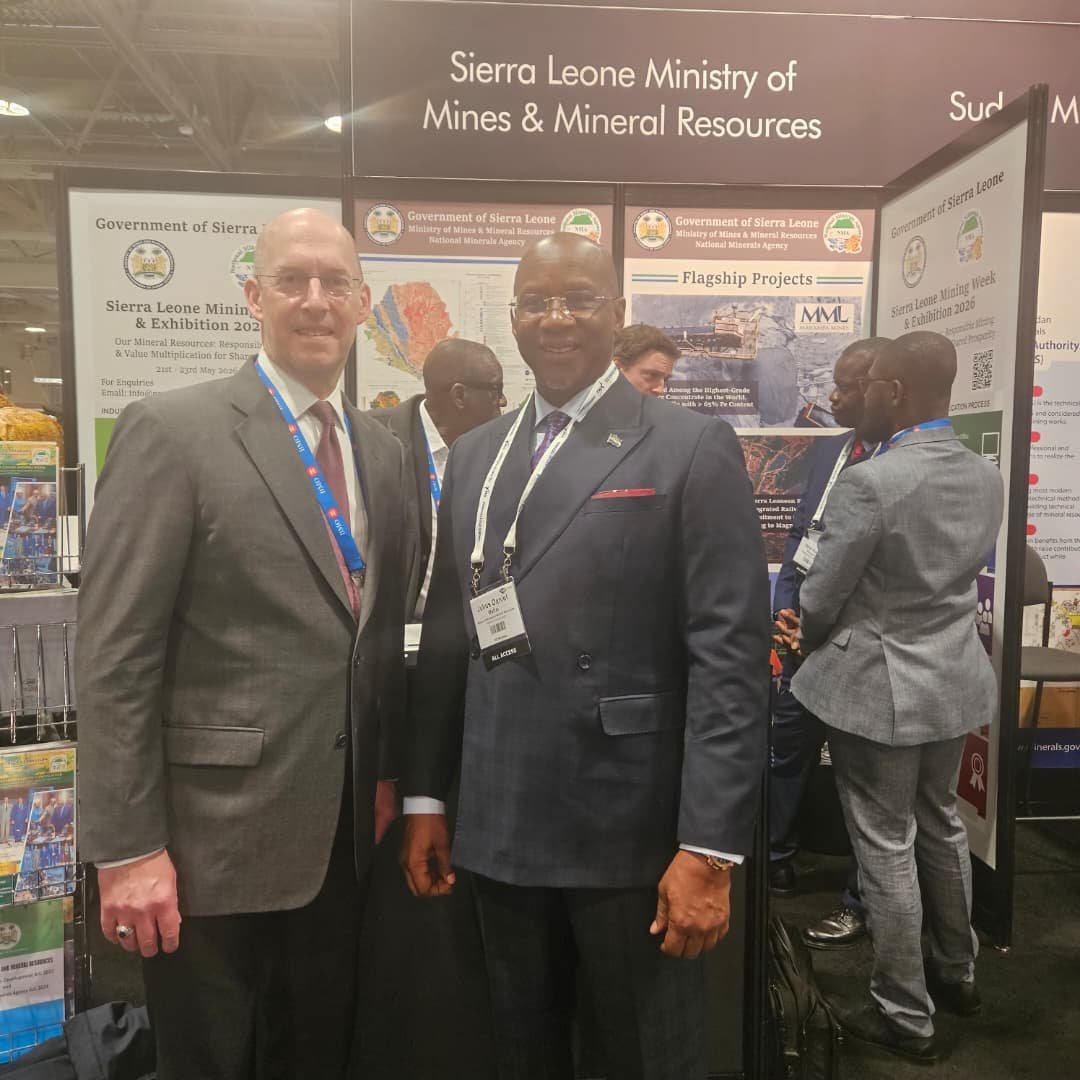
The Ministry of Mines and Mineral Resources and the National Minerals Agency announce the successful participation of Sierra Leone at the 2026 Prospectors and Developers Association of Canada (PDAC) Convention in Toronto (1-4 March 2026), where the Minister of Mines and Mineral Resources, Honourable Julius Daniel Mattai, delivered a commanding and visionary address at MineAfrica’s 27th Annual African Mining Breakfast and 24th Annual Investing in African Mining Seminar.
Leading a high-level delegation that included the executive leadership of the National Minerals Agency (NMA) Ing. Hadji Dabo, Director-General; Peter Bangura, Director of Mines; Joseph Lebbie, Director of Geological Surveys; Mohamed M. Bah, Director of Precious Minerals Trading; and Yusuf Summa, Manager of Large-scale Mining the Minister positioned Sierra Leone at the centre of a new, fairer and more strategic global minerals economy.
Hon. Mattai framed his intervention under the banner “Opportunity Africa: Sierra Leone’s Vision for Transformative Mining Partnership,” challenging the global mining community to reimagine its relationship with the continent and with Sierra Leone in particular. “The choice before us is stark: Will Africa remain the world’s raw material warehouse, or will we become the 21st century’s manufacturing powerhouse?” he asked, insisting that “the answer depends on what we do together starting now.”
He reminded the audience that Africa holds approximately 30 percent of the world’s known mineral reserves, including around 80 percent of global platinum and 70 percent of global cobalt, as well as significant lithium, rare earth elements, copper, graphite and nickel “the entire periodic table of the energy transition.” Sierra Leone, he stressed, condenses this abundance into 72,000 square kilometres rich in iron ore, rutile, bauxite, gold, lithium, rare earths, coltan, diamonds and heavy mineral sands, strategically located with direct Atlantic access through Freetown Port and underpinned by political stability and an English-language business environment.
In a speech that resonated powerfully with investors, policymakers and mining executives, Hon. Mattai was uncompromising about both the risks and the opportunities before the industry. “Critical mineral supply chains are dangerously concentrated,” he warned, noting that this reality creates unacceptable vulnerabilities for consumer nations, and asserting that “this is where Africa becomes indispensable.” He emphasized that African producers offer diversification, alignment with democratic values and partnership with nations committed to transparency and the rule of law, adding that for technology-leading democracies, “Africa is not an alternative we are essential.”
The Minister also spoke candidly about the infrastructure and financing constraints that hold back African mining, including low electricity access, limited road and rail coverage, and capital costs that are structurally higher than in developed markets. He described this as a “vicious cycle that can only be broken through genuine partnership,” and called out entrenched disparities in global capital markets, arguing that when African entrepreneurs pay 18–25 percent interest while their counterparts in developed economies pay around 3 percent, “this is not market efficiency this is structural disadvantage.”
At the same time, Hon. Mattai praised the transformational and visionary leadership of HE President Dr Julius Maada Bio and the resilience, creativity and ingenuity of the people of Sierra Leone and highlighted Sierra Leone’s governance and reform record, including four consecutive peaceful democratic elections, full compliance with the Extractive Industries Transparency Initiative (EITI), a modern Mines and Minerals Development Act (2023), and strong independent regulators in the National Minerals Agency and the Environmental Protection Agency. Yet, he noted, “investor perceptions lag reality,” and the “double standard is palpable and it costs Africa billions in foregone investment annually.”
Central to the Minister’s message in Toronto was Sierra Leone’s determination to move beyond raw material exports into domestic value addition, beneficiation and manufacturing. He outlined concrete initiatives already underway: heavy mineral separation plants, a national gold refinery, diamond polishing and jewellery manufacturing, and the development of a Critical Minerals Special Economic Zone with dedicated infrastructure, incentives and regulatory support. “These are not aspirational fantasies—they are concrete projects seeking investment partners,” he affirmed, stressing that when Sierra Leone processes minerals domestically, the country creates “dignified employment, skills transfer, revenue multiplication, industrial diversification, and supply chain resilience for consumers.”
Hon. Mattai’s address also carried a strong ethical appeal that resonated beyond the conference hall. “The global energy transition cannot be built on Africa’s perpetual underdevelopment,” he declared, pointing out the moral contradiction when minerals from countries like Sierra Leone power electric vehicles and advanced manufacturing, while only 26 percent of Sierra Leoneans have access to electricity. “We do not seek charity. We seek justice. We do not request assistance. We demand partnership. We will not accept permanent subordination. We insist on equal dignity,” he stated to sustained applause.
Looking outward to Sierra Leone’s traditional and emerging partners, the Minister was clear that Africa is no longer a passive actor. He underscored that the African Union’s Africa Mining Vision, the African Green Minerals Strategy and the African Continental Free Trade Area together provide a robust framework for value addition, regional integration and equitable benefit-sharing, while countries such as China, India, Turkey and Gulf states are already moving rapidly to seize the opportunity. “Africa will capture value from our minerals,” he said. “The question for traditional partners is whether you will be part of this transformation as genuine partners, or whether you will be sidelined as Africa diversifies relationships with those willing to offer what we need.”
The presence and active engagement of the NMA leadership in Toronto underscored Sierra Leone’s seriousness about translating this vision into bankable projects and predictable regulatory practice. Together with the Minister, the delegation held meetings with mining executives, investors and development partners, presenting a coordinated, technically credible and forward-looking case for investing in Sierra Leone’s mining and minerals value chains.
Concluding his address, Hon. Mattai left his audience and, by extension, the people of Sierra Leone and Africa with a clear challenge and a hopeful conviction. “Opportunity Africa is not a slogan. It is a commitment a commitment to genuine partnership, shared prosperity, environmental stewardship, and justice,” he affirmed. Sierra Leone, he said, “stands ready,” and the question he posed to the global mining community now echoes back home: “Are you ready to be genuine partners? I believe you are. I trust you will prove me right.”


