



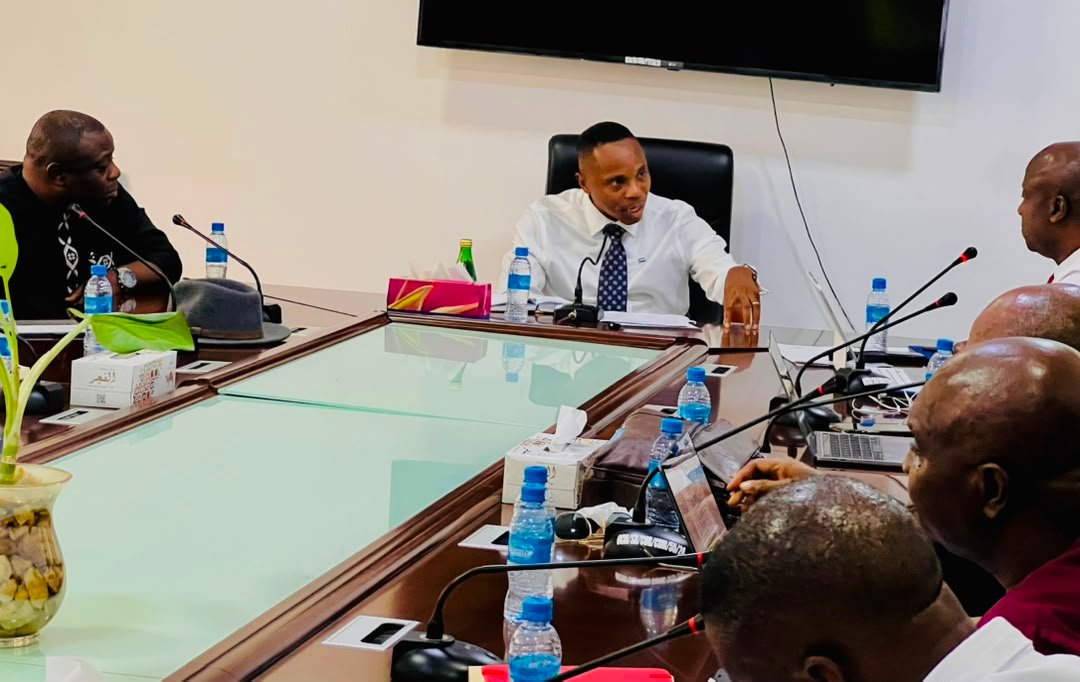
The Chief Minister Dr. David Moinina Sengeh has convened a Strategic Delivery Clinic with the Ministry of Transport and Aviation and its agencies to assess sector priorities, strengthen implementation coordination and ensure that planned interventions are aligned with Sierra Leone’s Medium-Term National Development Plan.
Opening the engagement, the Chief Minister explained that the Strategic Delivery Clinic provides an opportunity for government and sector stakeholders to brainstorm, examine ongoing programmes and develop a shared understanding of what is being implemented across the sector.
He stressed the importance of ensuring that all programmes and interventions are directly aligned with the priorities and commitments contained in the Medium-Term National Development Plan, noting that the exercise is intended to strengthen delivery and ensure that government’s plans translate into measurable results for citizens.
Presenting the Ministry’s priorities, the Minister of Transport and Aviation, Hon. Amb. Rtd. Col. Alhaji Fanday Turay, Esq., outlined the Ministry’s mandate, vision and mission, alongside a comprehensive set of interventions covering road, rail, air and maritime transportation.
The Ministry’s priorities include restructuring and strengthening the Ministry, reviewing transport policies, laws and regulations, developing a National Transport Policy, introducing an E-Mobility Policy, and establishing appropriate regulatory frameworks for commercial motorbikes and tricycles. The Ministry also outlined plans for a National Transport Master Plan, additional urban and intercity buses, improved Freetown–Lungi water connectivity and the mobilisation of resources for critical bridge infrastructure.
On road transportation, the Ministry presented measures aimed at formalising and regulating public transport operations, strengthening licensing and compliance systems, defining transport routes and operational corridors, and expanding private-sector participation in public transportation. Plans also include electronic ticketing, cashless payment systems, ICT-enabled transport management and the development of public transport infrastructure, including the tendering of terminals and parks in major cities.
Road safety featured prominently in the presentation, with planned interventions including strengthened road safety campaigns, revised safety regulations, vehicle safety policies, age limits for imported vehicles, pre-shipment inspections of used vehicles, improved standards for vehicle parts, driver knowledge testing, mandatory eye tests and expanded roadworthiness testing facilities. The Ministry also plans to pursue public-private partnerships for tow trucks and vehicle clamping services, while strengthening public awareness on safe road use.
The rail transport component focuses on laying the foundation for a sustainable national rail system through prefeasibility studies, the development of a regulatory framework and National Rail Master Plan, capacity building, training needs assessments, overseas technical training, operational manuals and an investment plan.
In the aviation sector, the Ministry outlined measures to improve airport infrastructure, navigation and communication systems, including completion of the Performance-Based Navigation Project, procurement of an Instrument Landing System, refurbishment of key aviation equipment and the procurement of transmitters. Other priorities include legislative reform, strengthening financial management systems and targeted capacity building for air traffic controllers and aviation personnel.
The aviation regulatory agenda further focuses on strengthening safety and security oversight ahead of the 2027 International Civil Aviation Organization (ICAO) security audit. This includes sector-wide gap analysis, inspector engagement, staff competency assessments, aerodrome safety training, drone-operation regulatory capacity, strengthening the Air Operator Certificate process and engagement with international aviation authorities to improve Sierra Leone’s standing on international safety lists. The Ministry also plans to develop surveillance plans for national and foreign operators, establish competency-based examinations for air traffic controllers, advance Bilateral Air Service Agreements and develop a National Aviation Safety Plan.
For maritime transportation, the presentation highlighted measures to modernise port operations, improve efficiency and strengthen maritime governance. These include the introduction of a single-window system, expansion of port CCTV coverage, modern port access-control systems, development of a comprehensive Port Master Plan, measures to decongest the port, establishment of inland container depots, expansion of haulage through public-private partnerships and port expansion.
The Ministry also outlined plans to strengthen shipping activities, operationalise the relevant joint venture arrangements and the Sierra Leone National Shipping Agency framework, increase the sector’s client base, strengthen partnerships with mining and shipping companies and enhance public awareness and collaboration across the maritime sector.
Maritime safety and security priorities include the procurement of a nationwide marine radio communication system, port facility security assessments, a national risk assessment for aids to navigation, rehabilitation of regional facilities, construction of outstation kiosks for maritime traffic regulators and the provision of life jackets. The Ministry further plans to develop maritime regulatory instruments, train seafarers to meet international standards, domesticate the Maritime Labour Convention and introduce a digital system for managing passenger and cargo manifests.
The presentation was followed by a detailed question-and-answer session, during which the Chief Minister, the Minister, heads of agencies and technical officials examined the proposed interventions, implementation timelines, institutional responsibilities and measures required to address potential delivery bottlenecks.
The engagement provided an opportunity to move beyond policy formulation and focus on implementation, timelines, coordination and measurable outcomes, ensuring that the Ministry and its agencies have a clear understanding of what must be delivered, by when and in line with national development priorities.
In his closing remarks, Minister Turay thanked his team and the agencies under the Ministry for their cooperation and commitment to working together to advance the sector’s priorities.
The Chief Minister, in closing, thanked the Minister, his team and the various sector institutions for their participation and commitment. He expressed confidence in their ability to deliver, noting that the commitments presented are consistent with the Medium-Term National Development Plan.
The Strategic Delivery Clinic forms part of the Government’s broader effort to strengthen performance management, improve inter-agency coordination and ensure that national development priorities are translated into concrete, trackable and timely results for the people of Sierra Leone


