



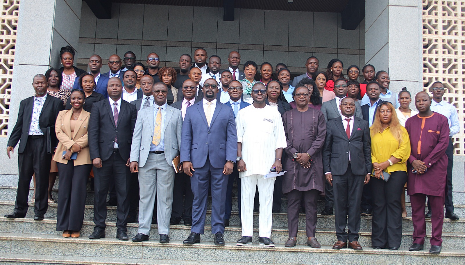
The Ministry of Foreign Affairs and International Cooperation has launched a three-day training programme on mediation and conflict management for junior and mid-level Foreign Service Officers as part of efforts to strengthen diplomatic capacity, peacebuilding skills, crisis response, and regional stability.
The training, held at the Ministry’s Conference Room, was officially opened by the Director General of the Ministry of Foreign Affairs and International Cooperation, Mr. Alan C. Logan, and brings together junior and mid-level officers for intensive learning in preventive diplomacy, mediation, negotiation, and conflict resolution.
Speaking during the opening session, Deputy Director General of Operations, Mr. Franklyn B. Fawundu, underscored the importance of the initiative, noting that mediation and conflict management remain essential pillars of diplomacy in an increasingly fragmented global environment.
He stated that although multilateralism continues to face pressure and trust among states is under strain, mediation remains one of the most effective tools for preventing escalation, bridging geopolitical divides, and securing lasting peace through dialogue rather than violence.
Mr. Fawundu further emphasized that diplomacy has played, and continues to play, a critical role in the peaceful resolution of crises across Africa. He noted that while mediation has its limitations, it remains among the most effective approaches to preventing, managing, and resolving conflict. He added that after decades of civil wars, violent conflict, and prolonged instability across the continent, Africa’s future depends largely on its capacity to prevent and address conflict effectively.
He stressed that equipping young diplomats with practical skills in preventive diplomacy and conflict resolution is indispensable to preventing conflict relapse, averting new outbreaks of violence, and promoting sustainable peace across the continent.
In his keynote remarks, Director General Mr. Alan C. Logan described the programme as timely and necessary, given the growing complexity, duration, and danger of modern conflicts to international peace and security.
He said Sierra Leone’s own history demonstrates both the devastating consequences of conflict and the enduring value of peace. He recalled that the country emerged from civil war through mediation, reconciliation, and peacebuilding and is now widely regarded as a strong example of post-conflict recovery and state-building.
Mr. Logan commended the role played by Foreign Service Officers in national peace efforts, noting that they supported high-level government delegations during negotiations that led to the Abidjan Peace Accord and the Lomé Peace Agreement. He also highlighted the Ministry’s post-conflict collaboration with the United Nations and other development partners in the formulation of the Peace Consolidation Strategy, ensuring that international support aligned with national priorities.
He further noted that the Ministry has contributed to mediation efforts across the sub-region, including dialogue with Guinea over the Yenga border issue and broader diplomatic engagement in countries experiencing unconstitutional changes of government. According to him, these experiences demonstrate that diplomacy is not only relevant, but also practical, strategic, and indispensable to peace.
Referencing current regional developments, Mr. Logan pointed to the crisis in the Sahel, particularly in Mali, Burkina Faso, and Niger, as evidence of the changing nature of modern conflict. He said governance challenges, insecurity, and political instability continue to shape the region, while the withdrawal of the three countries from ECOWAS and the formation of the Alliance of Sahel States have introduced new diplomatic pressures that require sustained dialogue and engagement.
He encouraged participants to make full use of the training to strengthen their skills in mediation, negotiation, and conflict analysis, stressing that diplomats must be prepared not only to respond to crises, but also to anticipate and prevent them. He emphasized that sustainable peace depends on inclusive dialogue, trust-building, and long-term commitment.
Mr. Logan also expressed appreciation to the United Nations Development Programme (UNDP) in Sierra Leone for supporting the initiative, and acknowledged Ministry staff and contributors who helped develop the training modules.
Declaring the training officially open, he expressed confidence that the programme would provide participants with valuable insights and practical tools to address conflict effectively and help shape a more peaceful and stable future for Sierra Leone and the wider region.


